How does Bitcoin mining work is where a specialized computer attempts to win a Proof-of-Work game. The game is used to provide evidence for Bitcoin transactions then, that these transactions will be appended to the Bitcoin transaction log.
The game is essentially used for creating another “ block ” to the block chain. The winner of the contest wins the block reward plus the transaction fees. A miner repeatedly hashes block data until the block has a required output. Network checks then verify the valid block, which is then added to the block chain.
It sounds technical, but at the most basic level this concept is surprisingly simple.
Let’s envision tens of thousands of machines bidding in a lottery at, say, hundreds of billions of trillions of attempts per second per machine, to the winner of which block would go to suggest the next block of Bitcoin transactions with a bonus for performing the labor.
It’s a really simplified description of mining bit coin.
Alright, so what is mining in terms of bitcoin?
It’s the way Bitcoin makes transactions into Bitcoin, puts it on a public block chain and makes the history of transactions resistant to being re-written through “Proof of Work”. Mining also provides the mechanism through which new bitcoin enters circulation.
Mining it is! It comes from extracting valuable resources out of the earth. However, there are no Bitcoin located somewhere inside of your computer.
The coins would be paid from the same hopper machine as they were entered, no miner’s pockets would be found with coins.
Rather miners give computational power to the Bitcoin network. Miners contest each other in generating a valid block adhering to Bitcoin’s protocol. Upon the correct generation and acceptance of a block by the network the miner could claim the block subsidy and appropriate transaction fees.
When you go back to this, defining the term Bitcoin and explain how does bitcoin work, it means you will get the answer of two questions. Miners assist in securing and transmitting the transactions in the bitcoin protocol. It’s incentivized with rewards to make it possible for miners to do this work.
Step-by-step of Bitcoin mining.
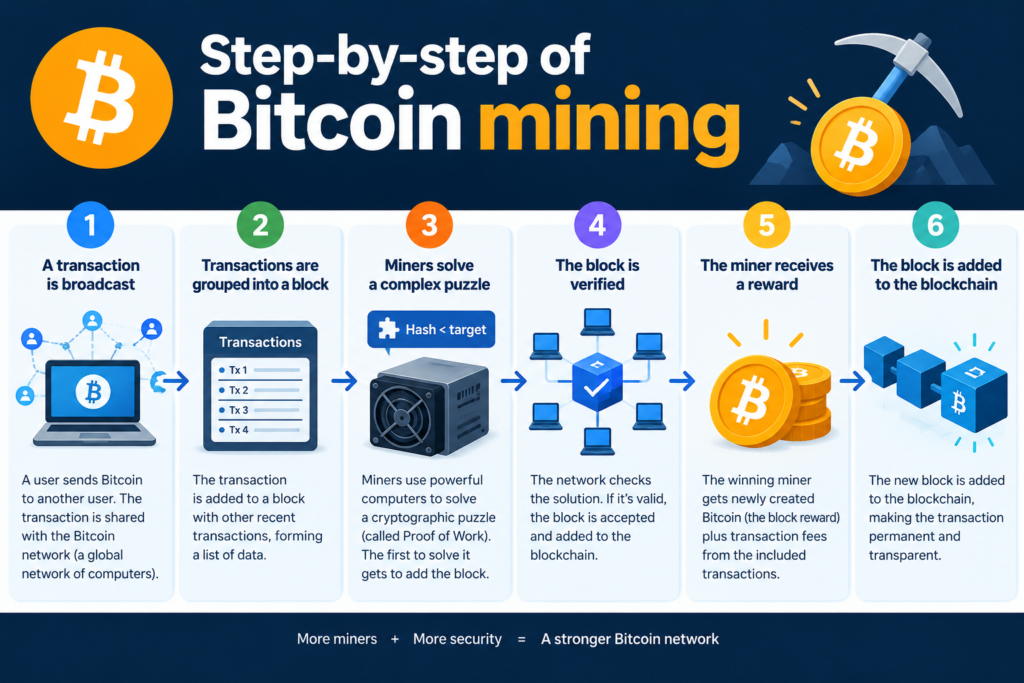
The simplest way to understand BTC miningis to just follow the block creation process.
1 The Bitcoin transaction sent over the network.
If Alice wants to give Bitcoin to Bob.
Her wallet creates and signs a transaction using her private key. The transaction is then broadcast to the Bitcoin network.
Additional Bitcoiners confirm the transaction to be valid, according to Bitcoin’s protocol: Did the spent bitcoins exist at the time, and was the digital signature good? A transaction is only considered officially settled and recorded in a confirmed block of the Bitcoin blockchain.
Unconfirmed Transactions can wait to be placed in a later block.
2. Miners collect transactions into a candidate block
A miner’s software selects transactions and builds a potential new block.
The block does not simply contain a random collection of payments. It contains transaction data plus information linking the new block to the existing blockchain.
The miner also creates a special transaction called the coinbase transaction. This is not the Coinbase cryptocurrency exchange. In Bitcoin terminology, the coinbase transaction is the special transaction through which the successful miner claims the block subsidy and included transaction fees.
3. The miner builds a block header
Miner: mycomputer creates the miner’s block header of data. Data for a Proof of Work.
The first place beginners often stumble is trying to remember every field. Don’t worry if you are new to all this, the last thing anyone wants is another thing for you to try and memorize right now! The point is that the header is the block itself, that can be repeatedly hashed:
Bitcoin’s developer documentation describes the block header as an 80-byte structure that miners hash repeatedly while searching for valid Proof of Work.
4. The mining machine starts hashing
And this is the stage where all the intensive computing tasks take place.
Each Bitcoin mining device randomly selects and flips a number (the nonce) while executing the block header through the hash function.
A Hash is fixed length result that is produced when we run data through a crypto hash function – you can compare it to a digital fingerprint.
The important part is that miners cannot simply calculate the answer from the transaction data. The process is repeated with a different input until either a hash comes out, or the input matches Bitcoin’s target to the best of your knowledge.
Which causes Bitcoin mining often referred to as a guessing game.
5. The miner searched for a hash lower than the target
In the Bitcoin Proof-of-Work, we need a valid hash of block header less than some target value.
This target value is adjusted according to the difficulty of Bitcoin. A lower target means valid hashes are harder to find.
One of the biggest myths surrounding Bitcoin mining.
So, the miner doesn’t solve some mathematical problem with one concrete answer. So they’re just guessing randomly to try and discover the target hash.
That distinction makes the entire process much easier to understand.
6. One miner eventually finds a valid result
Thousands of miners can be working on the same general problem at the same time.
Most attempts fail.
Eventually a miner discover a blockheader where hash value matches the target.
Once a successful miners discovers the solution the miner can send out the solution to the network.
7. Other Bitcoin computers verify the block
The rest of the network does not simply trust the winning miner.
Bitcoin nodes independently check whether the proposed block follows the protocol’s rules. This includes checking the transactions and the Proof of Work.
If invalid, nodes reject the block.
Provided that it is valid and thus is confirmed and included in the network’s own, confirmed chain, it also becomes another block in the Bitcoin blockchain.
8. The miner receives the reward
The miner who succeeded can claim that block subsidy as well as the fees within that block.
As a result of the April 2024 Bitcoin block halving, the Bitcoin block reward has been halved to 3.125 BTC per block. Different to transaction fees are block rewards, so when a person talks of their ‘3.125BTC mining rate’ they have in fact never even stated their true potential block reward.
It’s economic benefit that make miners waste capital (on hardware and electricity.
So what exactly does a Bitcoin miner do?
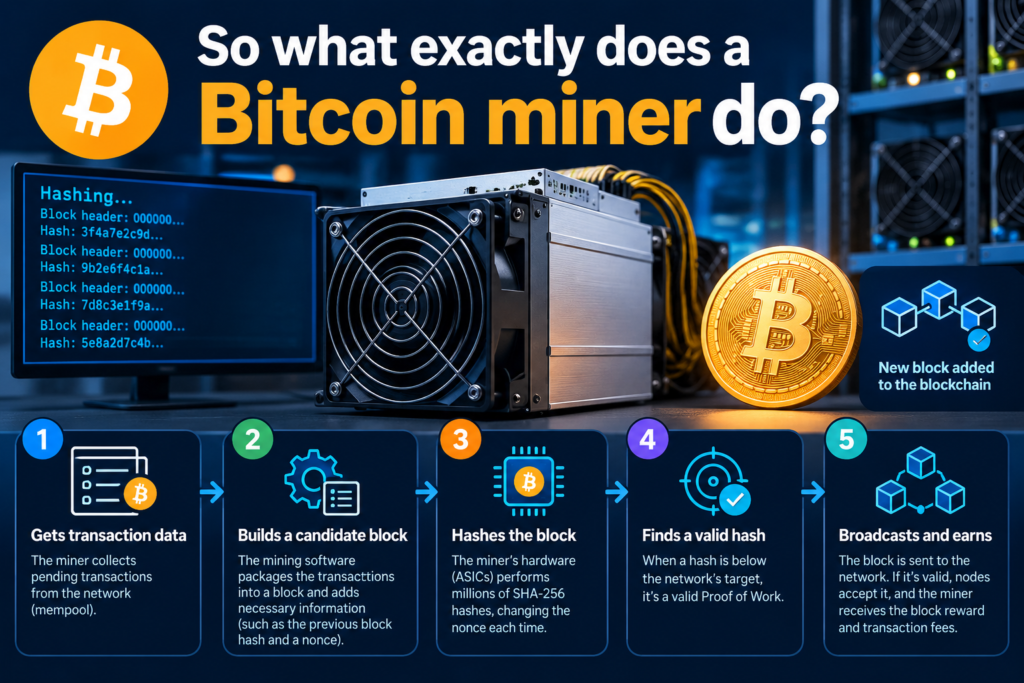
Ultimately, a Bitcoin miner is nothing more than a computer that performs a massive number of hashing operations.
Today the main mining operations run using Application Specific Integrated Circuit (ASIC) mining hardware. The term ASIC stands for ‘Application-specific integrated circuit’, and these machines are designed for the kind of hashing required to mine Bitcoin.
Which is a very big departure from the original days of Bitcoin where almost anyone with their standard computer was able to take a run at mining.
Seriousbitcoin mining today has developed into more of an industrial process-especially where it requires special hardware, power infrastructure, cooling solutions and mining farms- Coinbase notes that the computing requirements have increased dramatically as Bitcoin’s mining difficulty and competition have grown.
So if you’re asking “how does a Bitcoin miner work?”, think of it as a highly specialized machine performing an enormous number of hash attempts every second.
What Is Proof of Work?
A system named Proof of Work is what drives the competition in the mining industry, not solely in Bitcoin but generally among all virtual currencies.
A miner has to demonstrate that it performed substantial computational work before its block can be accepted.
The useful feature is that finding a valid result requires repeated trial and error, while checking a successful result is comparatively easy for other network participants.
That asymmetry matters.
It means someone cannot cheaply manufacture thousands of fake blocks and expect the network to accept them.
Bitcoin’s developer documentation explains that Proof of Work makes modifying historical blocks expensive because an attacker would have to redo the required work and continue catching up with subsequent blocks.
This is one of the reasons mining is about much more than producing new bitcoin.
This helps ensures the authenticity of the recorded transactions in the Bitcoin blockchain.
Bitcoin mining difficulty refers to.
This difficulty dictates how hard it is to find a valid block on Bitcoin.
Difficulty is also changed regulary by the network in order to avoid block creation too slow or too fast.
Adjust Bitcoin MiningDifficultyThe mining difficulty is updated in Bitcoin protocol each 2016 blocks. The difficulty target time frame is for that 2016 blocks and it comes out to around two weeks. Forcing a block to be mined at approximately 10 minute averages causes the system to adjusts for changing levels of mining activity.
Without miners uniting on adding massive hashing power, block times might be shorter than they currently are.
Difficulty adjusts in response.
This is an important reason Bitcoin does not simply become dramatically faster every time more miners join the network.
What Is Hashrate?
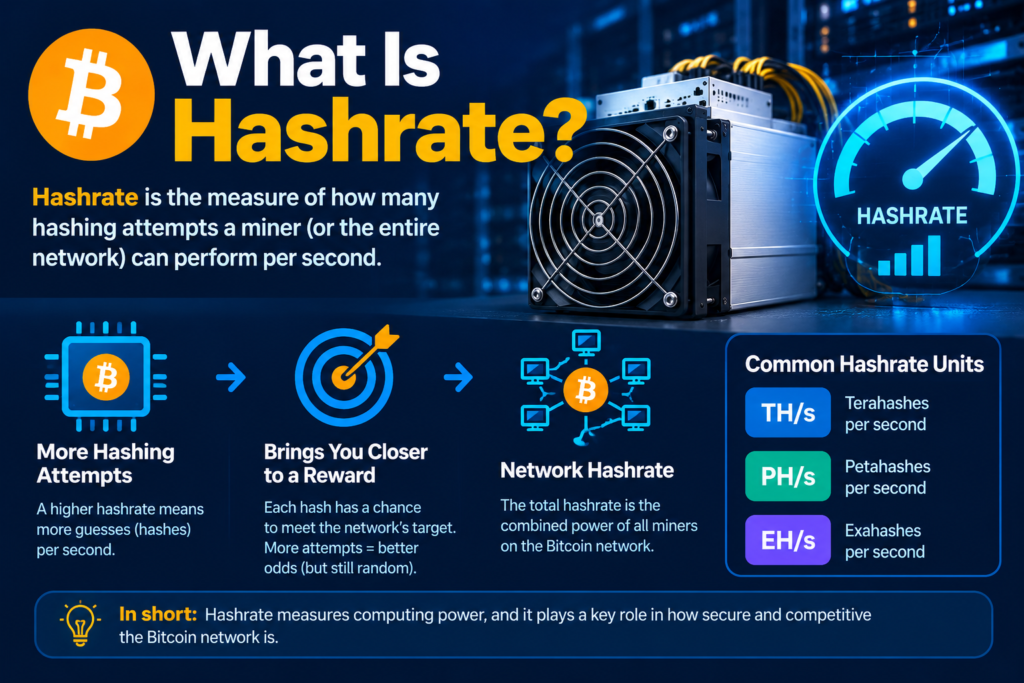
Hashrate describes how much hashing computation mining hardware can perform over time.
Compared with a smaller, lower hashrate miner-at the same efficiency-a more capable miner will be able to make that many more efforts per second.
Now, I’m no statistician, but let me offer an observation based on my everyday knowledge. Let’s suppose two gentlemen enter the lottery together; one had twice as many lotto tickets as the other, should he not have double the chance of winning?
While mining doesn’t involve drawing from a hat it helps illustrate why hashrate is relevant
The difference is that, instead of a human purchase, the contest between miners happens through computationally demanding work.
More hash-power on the network level also raises the cost for the attacker performing a certain attack against the blockchain.
How is bitcoin generated following the halving?
The Bitcoin supply is scheduled in a programmed way.
Block reward is approximately slashed by 2 each210,000 blocks. The fourth block halving took place at block 840,000 on April 20 th , 2024 which saw the mining reward halved from 6.25 BTC to 3.125 BTC per block.
Nexthalving anticipated to happen sometime around 2028. actualdate will depend on the speed at which blocksare generated.
The key thing here for beginners to grasp is that the new amount of bitcoin generated in each new block goes down over time.
Bitcoin’s maximum supply is designed around 21 million BTC.
With the diminishing of the subsidy, the transaction fees will grow in relative significance for long term miner revenue model.
Bitcoin Mining Pool: “How it works”
A miner does not have to mine completely alone.
Many miners participate in mining pools, where participants combine their computing power.
The pool coordinates mining work and distributes rewards according to the contribution of participating miners, subject to the pool’s payment system and rules.
The advantage is consistency.
A single miner, however tiny, could have an almost insignificant probability of mining a whole block at any particular time. By joining a pool that miner has smaller hashrate and potentially much smaller but frequent payouts.
Although on average the payday will be lower the single payday could be significantly greater for some. Also this will generate more randomness to the rate in which they will be uncovering blocks.
Such is why, for anyone who is in pursuit of knowledge regarding what’s the state of the mines, the fact of mining pools is far more appropriate than your off/on switch.
Is bitcoin mining resource-intensive?
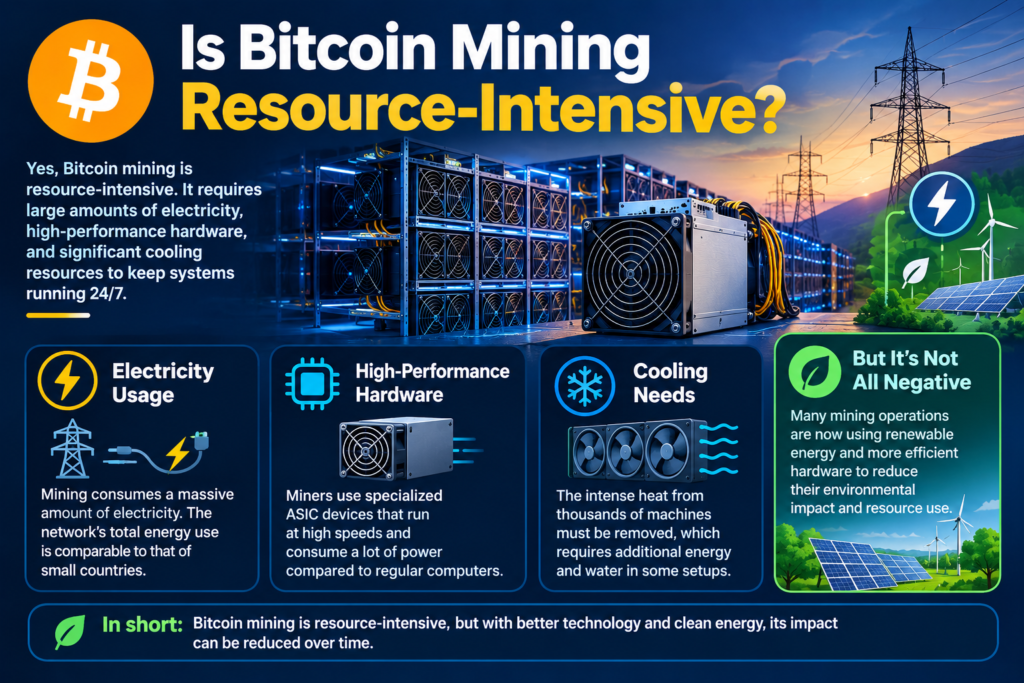
Yes.
This is the reason mining Bitcoin takes so much energy is because the number of calculations that the mining hardware does billions upon billions upon billions of times again and again and again.
Depending on what the Bitcoin network is doing, how much power it’s consuming will vary. Estimates vary as assumptions need to be made regarding what hardware is running on the network, the efficiency etc.. The Cambridge Bitcoin Electricity Consumption Index is maintained specifically to track the electricity requirements of the network.
A 2025 Cambridge study estimated annualized Bitcoin electricity consumption at about 138 TWh based on its survey methodology as of June 2024, while also reporting significant changes in the energy sources used by surveyed mining operations.
Numbers should not be made exact/permanent/final
This includes but is not limited to Bitcoin’s hashrate, hardware efficiency, electric costs and the economics of mining.
That’s also why you cannot trust people when they say ‘one bitcoin always costs X amount of kWh to mine’. Mining is a network-wide competition process, not a cooking recipe.
Can you Make money mining bitcoin?
There are indeed some who find that they can make money when mining Bitcoin. Just because you buy a mining machine does not mean to say you will make money.
A miner has to consider:
- Hardware cost.
- Electricity cost.
- Mining machine efficiency.
- Cooling and facility costs.
- Pool fees.
- Bitcoin’s market price.
- Mining difficulty.
- Block subsidy.
- Transaction-fee revenue.
- Hardware depreciation and maintenance.
This is one of the areas many basic introductions can be misleading:
It’s not just ‘How much bitcoin can this machine mine’.
It is in fact a better question to ask,
“Can the Bitcoin revenue generated by this machine exceed all of its operating and capital costs?”
For large mining operations, electricity prices and hardware efficiency can make a major difference.
So for the ordinary newbie whose electricity cost is very high at home it does not pay of to get an ASIC just because bitcoin price is high at the moment.
How to Mine Bitcoin on your Regular Laptop?
It is theoretically not disallowed for you to run mining software from your personal computer, with Bitcoin’s PoW system.
However in practice it can’t rival it for being a bit coin mining machine.
Today specialized ASICs are primarily used in Bitcoin mining. Competition in terms of scale means a normal laptop provides very little hashing power relative to a proper ASIC mining rig.
When running the mining software on your personal computer it generates the heat, noise, wears on hardware and generates electricity cost.
So you are never needed to get a mining machine just in order to study Bitcoin.
Then it can be interesting to understand how it operates or how to start and run mining company.
Why Does Bitcoin Need Mining?
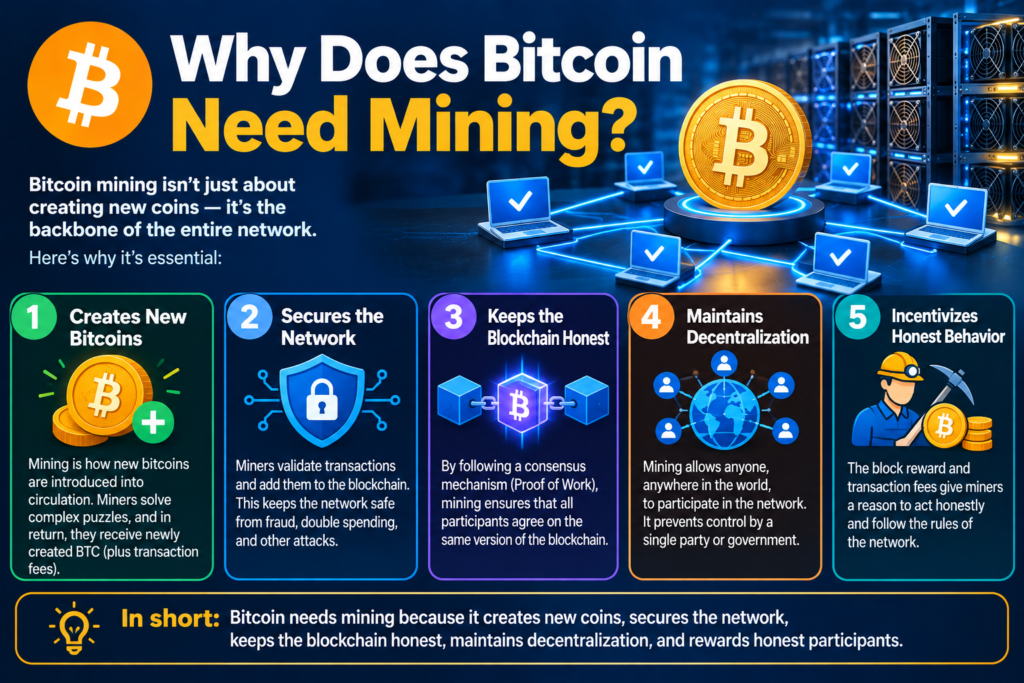
Bitcoin was designed to operate without a central authority such as a bank deciding which transactions should be recorded.
Mining helps the decentralized network agree on the order of transactions and which block should become part of the blockchain.
It also makes attempts to rewrite confirmed transaction history computationally expensive.
That is the deeper purpose behind the mining process.
The newly issued bitcoin is an incentive, but mining also provides the Proof-of-Work mechanism that helps Bitcoin maintain a shared transaction history without relying on one central organization.
Bitcoin Mining Vs. Crypto Mining What’s The Difference?
Mining: I’m sure you mean mining of the type that you do with Bitcoin, such as mining Bitcoin.
What is mining in cryptocurrency Mining refers toMining of any digital assets that are Secured using mining technology.
Not all cryptos mine.
Take Bitcoin for example. Bitcoin relies on Proof of work. But some other blockchain platforms rely on other methods like proof of Stake.
In other words, how does crypto mining work?, is not going to tell us exactly how does Bitcoin mining work?.
The precise steps depend on the specific cryptocurrency and its particular consensus mechanism, however.
A single, easy example of explaining Bitcoin Mining.
Imagine a situation where literally thousands of miners all race to make the next bitcoin block.
A miner then collects unspent transaction outputs that have accumulated as transactions. He bundles them into a new candidate block.
Its ASIC repeatedly hashes the block header while changing values such as the nonce.
Most resulting hashes do not satisfy the network’s target.
The miner keeps trying.
Eventually, one miner finds a valid hash.
It broadcasts the block.
Other nodes verify the block.
If that block has proven itself to be valid in Bitcoin terms, it might even become the next block in the chain.
Block Subsidy and Transaction Fees The success block will get the required block subsidy and fees.
After which the competition starts again for the following block.
There you go! Bitcoin mining in simple, easy to understand terms, no fluffy words used!
So, what do we mean by “mining” Bitcoin?
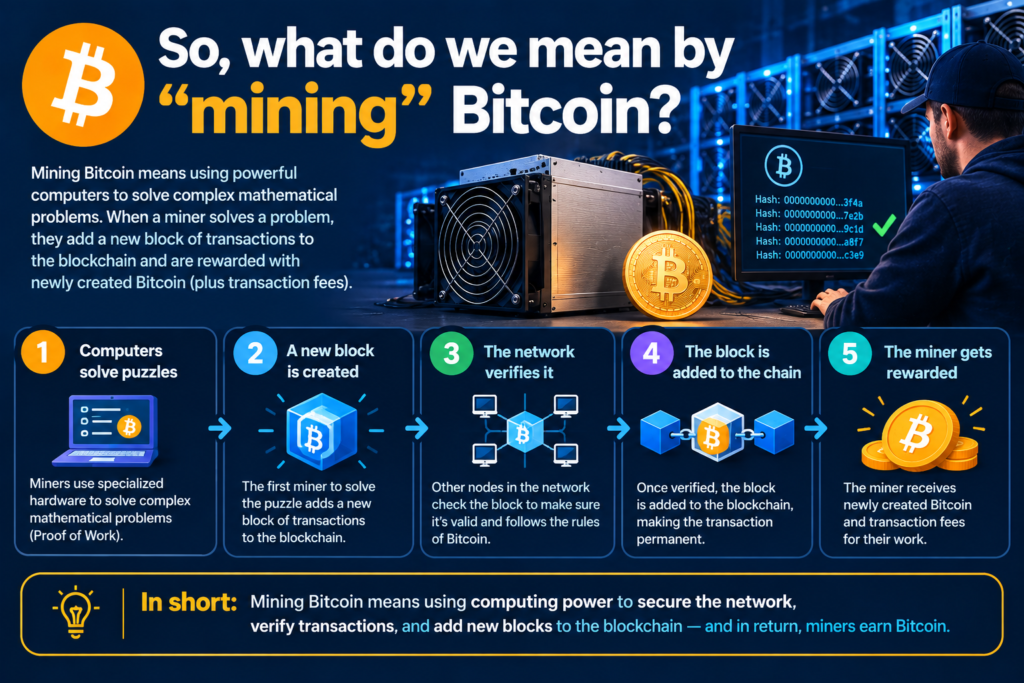
Minining the Bitcoin requires using your computer to find blocks of it through The Proof-of-Work process on the blockchain.
It’s not producing them manually.
This is not a puzzle where a computer has the solution beforehand.
It doesn’t assure any profit for the person who will be using the machine.
It turns into the game of rock, paper and scissors, where miners throw away their actual money for power to try to win the big prize money.
That’s the important bit that I really hope you get across.
The Main takeaway
But how does mining actually function in Bitcoin?
Bitcoin’s miner uses the specialized computers to constantlyHash the candidate blockdata- which happenst in a raceshaped for to create aHashwhich meets the blocktargetin use onthe network. The miner that successfully wins the race may announce the foundblock,which other nodes can thenvalidateand willadd to the blockchain; upon which the miner receives the reward of the block subsidy, and appropriate transaction fees
It is intentionally computationally expensive.
That cost contributes to make an manipulation of a decentralized list of transactions by Bitcoin difficult.
As a beginner only need remember this chain :
(FAQs) How does Bitcoin mining work?
1) And if you dig for one bit coin, what’s your profit to get out?
There is not an appropriate amount of time. But the reward is 3.125BTC a piece and the bitcoin mined is around every 10 minutes. The expected time one individual would take relies on the individuals Hash rate relative to the whole networksHash rate
2) And what then, once all of the 21,000,000 bitcoins are out of the ground?
All the Bitcoins have now been mined. Miners will continue to provide security for the bitcoin network, but in this case will receive the fee instead of in bitcoin.
3) Should I mine Bitcoins?
Yeah, but it does not mean they’re making money. The cost of electricity, hardware efficiency, the price of the bitcoin, difficulty of mining and any fees involved all play a part in a miner being profitable.
4) Can I mine bitcoin? Is bitcoin mining illegal?
Depends really on what country you’re in. In certain regions Bitcoin might operate in, it could also be limited or be entirely prohibited in others. Get in touch with local authorities before digging.
5) Could you clarify, how do we know who has got most Bitcoin, if possible?
Bitcoin. In almost everyone’s opinion, Satoshi Nakamoto has by far the largest slice of the bitcoin pie (roughly 1.1 million bitcoin, no one really knows for sure how many though).