

‘Incfidelibus’ is not Latin. Latin: infidelibus – This is close, ‘of or relating to infidelis‘: – unfaithful, disloyal, or Faithless. – Unfaithful. It’s the extra ‘c’ in there and the devil knows where that’s from without a much better story.
That’s the simplest answer to that question. But what is really important and interesting is to ask what makes infidelibus so tempting, what does infidelibus mean, and what makes both spellings confusing in isolation.
What does incfidelibus mean?
The safest answer is that incfidelibus does not have a securely established independent meaning in standard Latin references.
That does not mean nobody has ever typed or published the spelling. It clearly exists online and has attracted enough attention to produce a growing collection of pages about its supposed meaning and origin. Current search results repeatedly describe it as a nonstandard spelling closely related to infidelitas.
The distinction matters.
17 Should the user ask to be told the definition of incfidelibus as though the word were the dictionary entry, then there is not much cause for giving it. If the textwriter has indeed used the word then the way to approach it is to revisit the sentence and gather the information or content within that context. After you do this then consider text of the words and see if the textwriter meant for form, infidelibus.
This is an example of that situation when one letter alters the linguistic problem altogether.
Is incfidelibus a real Latin word?

There is no good evidence in the established Latin references checked for treating incfidelibus as a standard Latin grammatical form.
By contrast, infidelis is well documented.According to Lewis and Short, infidelis means “untrustworthy,” “untrue,” “faithless,” “unbelieving,” in addition to the ecclesiastical Latin meaning of “a unbeliever” at a much later date.
That distinction is much stronger than simply saying that incfidelibus “looks like Latin.”
Inflected Language Latin. The Latin language is inflectional Case changing form in the sentence. Therefore when they convert form to form it is necessary to figure out the ‘underlying dictionary form’. The family road that is going to trace the document will bring us to the infidelis, not at an entry in a lexicon under incfidelibus.
The extra c therefore deserves caution rather than a made-up definition.
So what is the right spelling of incfidelibus or infidelibus?
However, if by this you refer to the Latin grammar term associated with the word infidelis, then you should write infidelibus, with no c.
This is substantiated by Latin inflectional evidence. Infidelis is a third declension adjective, and infidelibus is the dative/ablative plural form of the same.
Thus the comparison is clear:
Incfidelibus is an unusual, nonstandard spelling whose independent Latin status is not established.
Infidelibus is a documented Latin form belonging to the infidelis word family.
That does not prove that every occurrence of incfidelibus is necessarily a simple typo. Someone could deliberately use the spelling as a username, invented term, title, brand, fictional expression, or modern variation. What cannot be done responsibly is take that modern spelling and automatically give it an ancient Latin history.
What does infidelibus mean in Latin?
This is where the question becomes more interesting because infidelibus does not have one fixed English translation.
The word comes from infidelis. The definitions for infidelis from Lewis & Short include unfaithful, faithless, and in Ecclesiastical Latin, unbelieving or “infidel.”
The ending -ibus is important because it shows that we are dealing with an inflected form. As far as *infidelis* is concerned, *infidelibus* can be either the dative or the ablative plural.
English does not follow that pattern of reproducing those case endings from Latin. In this way, the translation becomes naturally dependent on the full sentence.
This could be translated as “to the faithless,” “with the faithless,” or some other variation on that theme.
However, “the unbelievers” is one translation that can fit in this religious context, but this does not mean that it must be the only translation.
This is one of the crucial points that is left out of many brief descriptions of the word.
Where does infidelibus come from?

To understand infidelibus, start one step earlier with fides.
Lewis & Short Fides has a meaning involving faith, trust, confidence, dependence, credibility, etc.
Then, we find the word “fidelis” in the family, where the meaning of the word in its noun form is akin to that of “trustworthy,” “sincere,” “genuine,” and “devoted.” “My earlier dictionary note of him includes quotation from some more classic Latin writers eg. Cicero, Livy, Horace etc.
Then comes infidelis, which moves in the opposite semantic direction.For the moment, lexicographers have not been able to find equivalent primary sense of the noun: the translated sense only is recognised: unfaithful or faithless.
Lewis and Short on etymology for this word with several interesting examples of usage in authors. Also points out the latter day use as a noun to signify loss of belief in a particular subject matter or deity.
Lastly, infidelibus is also a form of infidelis.
So the linguistic chain is much better documented as:
fides → fidelis → infidelis → infidelibus
The word incfidelibus does not fit that documented spelling pattern.
Why does the extra “c” create so much confusion?
Because incfidelibus looks plausible.
To a person who is not acquainted with Latin, it is very easy to think that the additional letter must have been a prefix or something like that. Search engines can make the effect even stronger when multiple websites repeat the same explanation.
But repeated online wording is not the same thing as historical evidence.
Several current pages suggest that the extra c could have come from transcription, scanning, OCR, or copying errors. Those are reasonable possibilities, especially for unusual spellings found in reproduced texts, but the available pages do not establish one specific event as the origin of incfidelibus.
That difference is worth preserving.
Saying “the spelling may be the result of an error” is a defensible explanation.
Saying “the spelling definitely originated from one particular OCR or transcription mistake” requires evidence that has not been demonstrated here.
Is incfidelibus a misspelling?
Perhaps, and possibly in most cases it intends to signify infidelibus, but that does not mean that the etymology of the word has been proved.
In cases of a Latin author, a translator, a text taken from a MS, or the case of the word “infidelibus” in a dictionary text you would have guessed to appear as incfidelibus this is usually the most sensible correction.
Context is still relevant.
Imagine finding the spelling in a modern username. It will not be necessary to correct it as username can be created. It will be the same case for a fictional title, name of website, company or distorted expression.
In that case, the question is: Did the author attempt to use the Latin word that already existed?
If yes, infidelibus is the form supported by the grammatical evidence. If not, incfidelibus may simply be a modern constructed spelling with no traditional Latin meaning.
What is the literal meaning of infidelis?
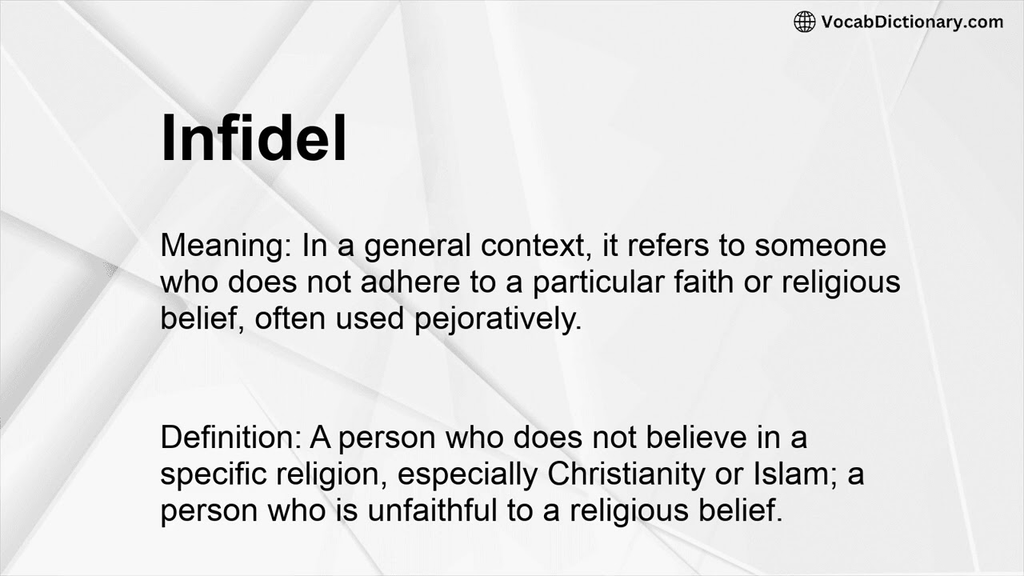
The literal sense should not be reduced to one modern English word.
The Lewis and Short entry describes infidelis as “that cannot be relied upon,” followed by “unfaithful” and “faithless.” It also captures an ecclesiastical Latin meaning relating to disbelief.
This makes for the word to have more extensive connotations compared to the English word infidelity that refers to adultery or betrayal in marriage.
The etymological meaning of the word in Latin can be translated into English as trust, fidelity, reliability, or belief.
That connection becomes clearer when fidelis is considered. Fidelis is defined in dictionaries as being reliable, loyal, honest, and true.
It is not just another unknown old word equivalent to one contemporary English term. It belongs to a broader family built around concepts of trust and faith.
Does infidelibus always mean “unbelievers”?
No.
This is one of the most common mistakes in translating the word.
The dictionary entry of Lewis & Short includes the religious definition of “infidelis”, but it also includes other classical definitions, such as that of unfaithful and faithless.
Infidelibus may be understood from the context of the sentence in which it is found.
A religious or theological passage may lead to an English translation involving unbelievers.Another context could be about individuals who are dishonest, disloyal, or unfaithful.
This is why a definition from the dictionary cannot be regarded as a complete translation.
What is the distinction between incfidelibus and infidelibus?
It’s just one letter different, but that one letter makes all the linguistic difference.
It is proven that infidelibus is a grammatically correct form which is inflected from infidelis. Incfidelibus lacks this proven grammatical ground within the references used in this article.
The safest comparison is therefore not “two Latin words with slightly different meanings.”
It is documented form versus uncertain spelling.
This is actually a far more accurate depiction of their dynamic.
If the document from which you are working is meant to have Latin and you need to choose which spelling to use, then use infidelibus where appropriate.
Does incfidelibus have a known historical origin?

Not one that can be established confidently from the evidence available here.
This is where many online explanations become too certain. Some pages suggest an OCR error, transcription mistake, copied typo, or similar explanation, but a plausible explanation is not the same thing as a documented first occurrence.
I found no reliable primary source in the material checked that identifies a first recorded use of incfidelibus or demonstrates the exact document in which the spelling first appeared.
That means the honest answer to “incfidelibus origin” is currently more limited than some search results suggest.
Its linguistic resemblance to infidelibus is clear.
Its exact origin as a spelling is not.
Is incfidelibus a Neo-Latin term?
It would be premature to conclude that incfidelibus is a true term in Neo-Latin.
Neo-Latin is a collective noun for a large corpus of Latin literature written in subsequent centuries, and a word isn’t a Neo-Latin word just because it resembles Latin and can appear online these days.
Such a classification would have required the existence of historical textual evidence of the deliberate employment of the spelling within some relevant Latin tradition.
Infidelis, on the other hand, has historical evidence that is well documented; from the classical to ecclesiastical literature.
So calling incfidelibus an ancient, medieval, or Neo-Latin expression without a source would go beyond the evidence.
Why does internet usage make the word harder to understand?
Search engines reward words that have enough online material around them to answer a query. Once an unusual spelling begins appearing on multiple websites, later writers can end up describing the online explanations rather than checking the original language.
That creates a feedback loop.
One page says the word has a particular meaning. Another page repeats it. A third page expands the explanation. Eventually, the repetition can make an unsupported claim look historical.
The current search results for incfidelibus show exactly why source checking matters. Many pages concur that the spelling is peculiar and similar to “infidelibus,” but there is a variation on their assurance as to the source of the additional c.
The lexical evidence is much stronger for infidelis and infidelibus.
What should you write if you need to explain incfidelibus?
In case you are writing an article for the general public on this term, the most precise language to use would be:
incfidelibus incfidelibusis a rare nonstandard form of the more common Latin incfidelibus. The form listed is from infidelis which means: (i) of the faith: unbelieving, unfaithful; (ii) faithful to any cause: disloyal, unfaithful to (an engagement etc.), inconstant, treacherous, perfidious. There was not evidence in the material analyzed about the source for inserted c in incfidelibus.
That formulation does one thing which the latter two cannot do – it differentiates between the known and the inferred.
It also prevents making a potential error in spelling into an imaginary historical term.
(FAQs)
1 What does incfidelibus mean?
Incfidelibus is a Latin word whose independent meaning has not been firmly established. It is almost identical to infidelibus, which is a Latin word that has been recorded.
2 What does infidelibus mean?
Infidelibus is infidelis in the ablative and dative plural. There is no single translation for this particular Latin word ‘infidelibus’ throughout the various sentences. They can be : unfaithful, for unfaithful, unfaithful in or unto faithless, or through the faithless, or by the disbelievers .
3 Is incfidelibus a real Latin word?
There does not seem to be any authority for the spelling incfidelibus in the major Latin dictionaries consulted. However, the closest known spelling is infidelibus.
4 What is the correct spelling, incfidelibus or infidelibus?
Regarding the Latin equivalent for “infidelis,” the right spelling would be “infidelibus” without an extra “c.”
5 Is infidelibus a Latin word?
Indeed. It is the conjugated form of the Latin adjective infidelis. Lexical evidence proves that infidelibus is its plural dative/ablative form.
6 What is the origin of infidelibus?
It belongs to the word group of infidelis which has relationship to fidelis and fides. The meanings of fides include faith, trust, confidence, belief, and reliance.
7 Is incfidelibus just a typo?
It could very well be just a typo or some other kind of mistake in copying. Nonetheless, the specific origin of this particular spelling mistake is not certain based on all the evidence studied; therefore, it is probably safer to avoid presenting any one hypothesis as factual history.
The bottom line on incfidelibus
The term “incfidelibus” must be understood to be a dubious or irregular form, not a Latin term that has a specific definition in the dictionary.
Based on the more robust evidence from linguistics, the origin is infidelibus, a Latin word that originates from the adjective infidelis, which has been documented as meaning unfaithful, faithless, unreliable, and unbelief in ecclesiastical Latin.
This extra ‘c’ makes incfidelibus weird to read. Since the underived form probably should be infidelibus it can be assumed that a transcription error or source digitising error had taken place, but with just the one instance of its use we can not deduce the usage in the source material.
And if you were to look up “incfidelibus meaning,” “what is incfidelibus,” “incfidelibus Latin meaning,” or “incfidelibus correct spelling,” the actual answer to your question is very straightforward: did they mean infidelibus?
If you’re reading a version of a document or sentence where incfidelibus shows up, that should probably be your next step. The context of this word might imply it’s just a typo or even a word someone made up on purpose; you might be wanting to go the extra mile and research where you found the source.




Comments 2